Most Wednesdays, the dead were burned at the crematorium.
At that time, the woman and the man lived some distance from this crematorium. The two of them, the man and his wife, were temporary strangers to this Land of the Rising Sun.
But on those days when the dead were properly committed to the afterlife and the sacred held, the woman and her husband still made sure the washed clothes that she’d earlier pegged on the clothesline were brought in, least the smell of burning flesh permeate all.
The clothesline was strung between a wooden pole and a great cedar down the slope behind their house, past the long dull upright steel propane cylinders that provided their fuel for cooking.
You arrived at that place on the slope through an old wooden gate, an almost demarcation between the profane and the sacred, the new and the old, life and death. A stand of ancient great cedars began just after the gate and followed the contours of the slope down to the slope’s base to a flat plain spread out over a modest valley where the Japanese families lived and tended and maintained their own gardens, and to the watery reflections of the flat rice paddies beyond.
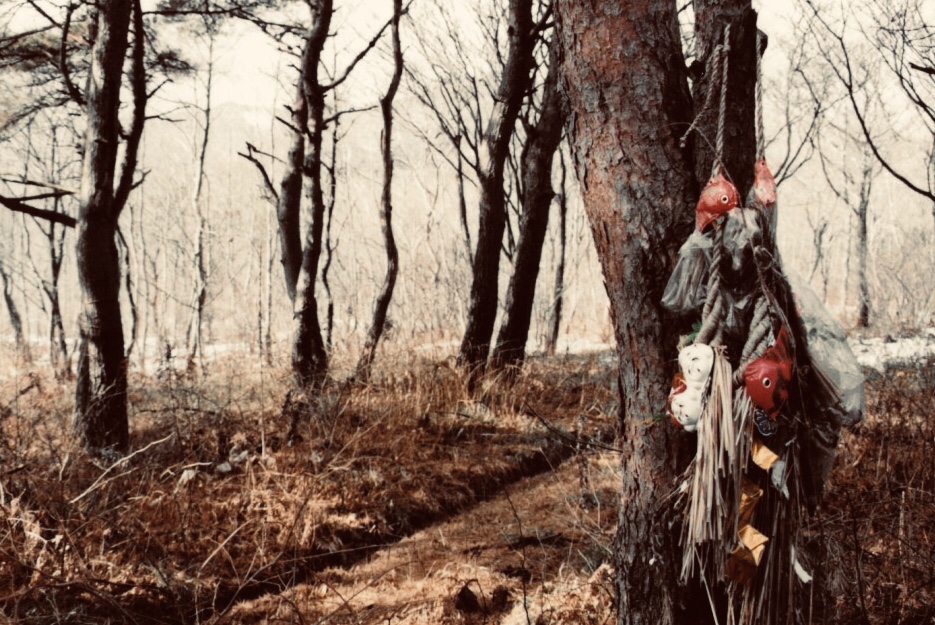
The woman called the place past the gate where the cedar stand started her “hidden garden” and once told her husband that the garden seemed as old as forever and she felt, at times, that something old and unseen inhabited the dark tangle of the cedar stand.
And the woman and her husband thought of themselves as sensible, educated people who were not subject to these kinds of thoughts; but nevertheless, on the long dark snowy winter nights as the two of them drank warm saké in front of the flickering light and shadows cast by the kerosene heater, they had found themselves positing questions of this nature, unanswered.
And once upon a time in the late summer and after the monsoon rains ended and Obon concluded and, on that particular late afternoon, the air was still and hot and the humidity high, and in the background the specter of the coming fall was present as a phantom is before the coming of night.
And on that particular afternoon the man arrived at their little house that had a faded orange sheet-metal roof, and he happened upon his wife in the vanishing late-afternoon orange light as she tended to the last of the season’s vegetables growing in the black fertile volcanic soil of her hidden garden.
She squatted, and wore nothing except her bare tanned skin and a broad sugegasa on her head.
She hears him pass through the gate.
She looks up to her husband as he now stands next to her. He wears the military uniform of their country.
She shrugs. “It was hot.”
“It is hot, yes,” he says.
A rueful smile crosses her lips.
He smells the fertile, worked soil turned for months by her hands. Her back is wet with her own sweat and shines in the long light of the afternoon sun.
He offers her his hand.
She takes it and rises to her feet, feet muddy from the moist earth, and cool in her open-toed sandals.
She turns to her husband, her hand still in his.
The man sees his wife’s familiar body, nude and glistening with perspiration. A smear of dirt is high on her thigh.
A line of clear sweat moves over the contours of the skin of her smooth groin to beneath her belly button.
The moisture continues down and down and down before disappearing; now lost in her dark tangle of pubic hair that heralds her womanhood.
As he himself has found himself lost in her dark tangle so many times before.
She is aware her husband’s eyes move over her body. She is aware her husband craves her, wants her. At this moment. She knows this, her nipples firming from arousal.
Because the rain begins to sweat from a darkening sky and the afternoon is late, and because of this and nothing else, she takes a step to her husband and he lets her hand go and takes hold of her bare waist, and he pulls his wife to him.
Because of this and nothing else as that once-upon-a-time afternoon grows old and tired, and ancient ghosts wake from their slumber, and inside the house the man slowly washes the mud from his wife’s feet, wipes the dirt from high up on her bare thigh, and she opens to him, and her lips find his.
Because of this and nothing else the rain comes down in a gentle mercy and pounds the faded orange sheet-metal roof of their small house and soaks their washed clothes still pegged on the clothesline past the gate in the dark tangle of cedars where the ghosts move.
Because of this and nothing else, eventually and in the dark tangle of the night, their futon finally sighs.
And the ghosts move on.
 mattlaneydotcom